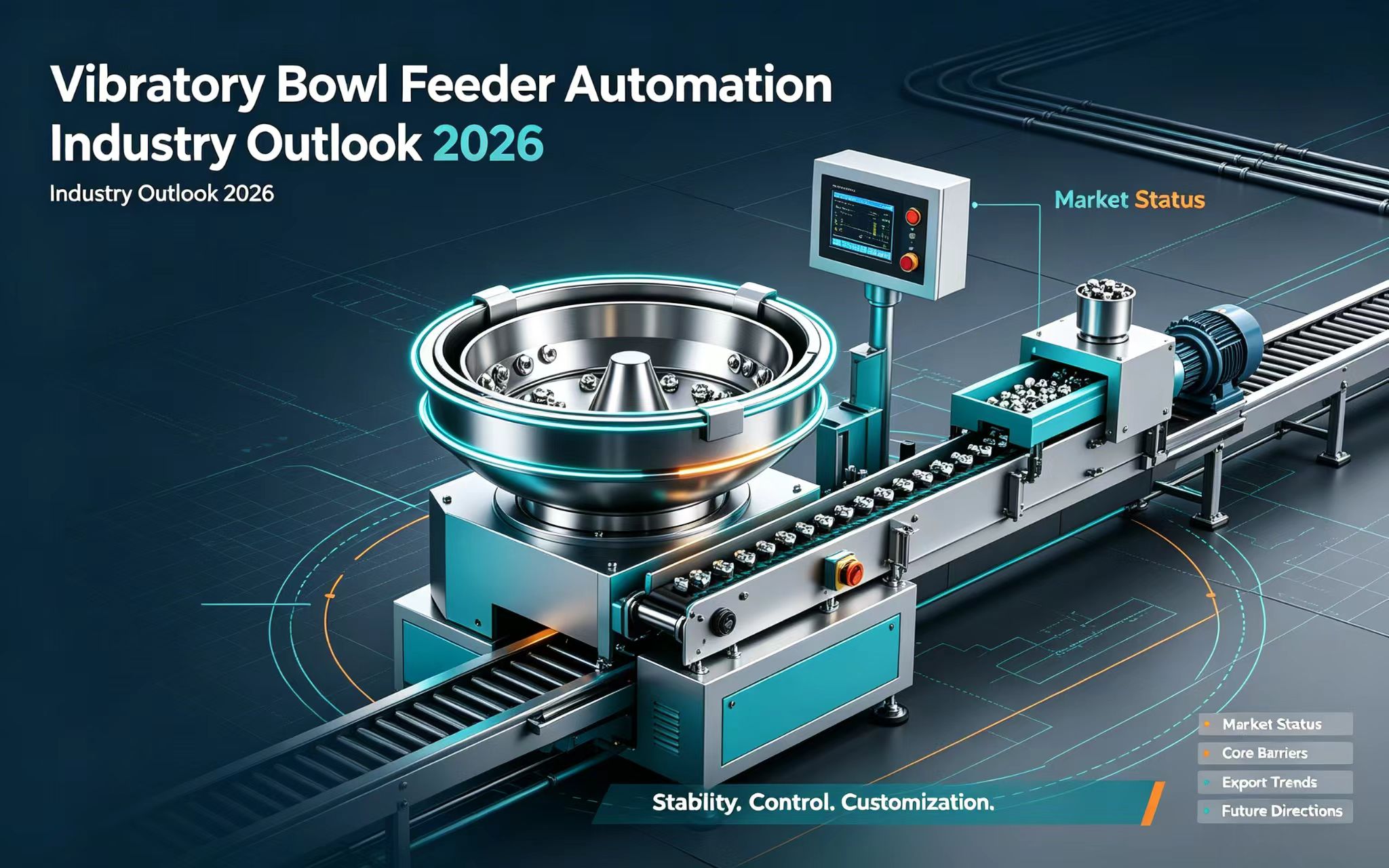
Industry Analysis of Vibratory Bowl Feeder Automation Equipment: Current Status, Competition Landsca
With the continuous acceleration of global manufacturing automation and intelligent upgrading, non-standard automatic feeding equipment has become an indispensable core component of intelligent assembly lines. The automated feeding system composed of vibratory bowl feeders, linear vibrators, vibrating storage hoppers, centrifugal feeders and intelligent digital voltage regulating control systems is widely adopted in precision electronics, hardware fasteners, automotive components, agricultural fittings, medical devices, plastic products and many other industries.
In 2026, the vibratory feeder industry has entered a new phase featuring structural upgrading, refined competition and rapid export growth. The industry has completely stepped away from the extensive competition model that only focused on sheet metal pricing and appearance, and entered an era of high-quality competition centered on equipment stability, intelligent electronic control systems, non-standard commissioning technology and customized manufacturing capabilities for segmented industries.
1. Current Industry Status: Expanding Market and Upgrading Customer Requirements
Rising global labor costs, growing labor shortages and accelerated automation retrofits for overseas factories have steadily expanded the market for automated vibratory feeding equipment. Both domestic smart manufacturing transformation and capacity relocation in Southeast Asia, the Middle East and Europe & America maintain positive growth momentum for vibratory feeder demand.
The purchasing logic of buyers has undergone fundamental changes:
Demand for low-end standard vibratory bowls keeps shrinkingBasic vibratory bowls have low entry barriers, serious homogenization and high failure rates. They can only handle simple workpiece feeding and cannot meet the requirements of modern high-precision, high-cycle and long-running automatic assembly lines. The low-price segment suffers from fierce competition and shrinking profit margins.
Demand for mid-to-high end customized and intelligent vibratory feeders is boomingOverseas purchasers and automation system integrators pay more attention to anti-jamming performance, feeding stability, noise control, feeding accuracy and adjustable intelligent control systems. Intelligent vibration control systems with digital voltage regulation, constant amplitude stabilization, frequency fine-tuning and multi-country voltage adaptation have become mandatory standards for high-end procurement.
Segmented market demand becomes increasingly prominentTiny plastic parts and precision hardware components for 3C electronics require ultra-precision, low-damage and low-noise feeding solutions. Large irregular agricultural fittings and heavy workpieces demand heavy-duty, high-output and anti-blocking feeding equipment.Segmented specialization has become the most notable market characteristic in 2026.
2. Competition Landscape: Core Barriers Lie in Technology and Practical Experience
The vibratory bowl feeder industry has long been characterized by a market pattern: low barriers for sheet metal processing, but scarce high-quality suppliers with advanced technology.
A large number of small workshops only have basic sheet metal fabrication capacity. They lack professional commissioning teams, independent R&D of control systems and standardized quality control systems. These manufacturers rely solely on low pricing to capture low-end orders. Their products commonly suffer from unstable feeding, frequent jamming, amplitude drift, excessive noise, short service life and inadequate after-sales support, resulting in uneven product reputation across the industry.
Three core competitive barriers separate outstanding suppliers from ordinary manufacturers:
2.1 Rich hands-on commissioning expertise
Vibratory bowl feeders are not standardized machinery. Around 70% of equipment stability depends on commissioning craftsmanship.Manufacturers with senior assembly and commissioning technicians with over 20 years of practical experience are capable of solving complex feeding challenges for irregular, scratch-prone, uneven-thickness and easily jammed workpieces. This advantage cannot be replicated by small workshops.
2.2 Self-developed intelligent electronic control systems
Traditional analog controllers feature low precision and poor voltage stability; amplitude fluctuation easily causes workpiece misfeeding, and such controllers are gradually phased out of the market. Suppliers with self-developed digital voltage regulating controllers can realize constant amplitude, precise fine-tuning and adaptive voltage. Stable operation of control units has become the top selling point favored by overseas foreign trade customers.
2.3 Specialized production layout for segmented markets
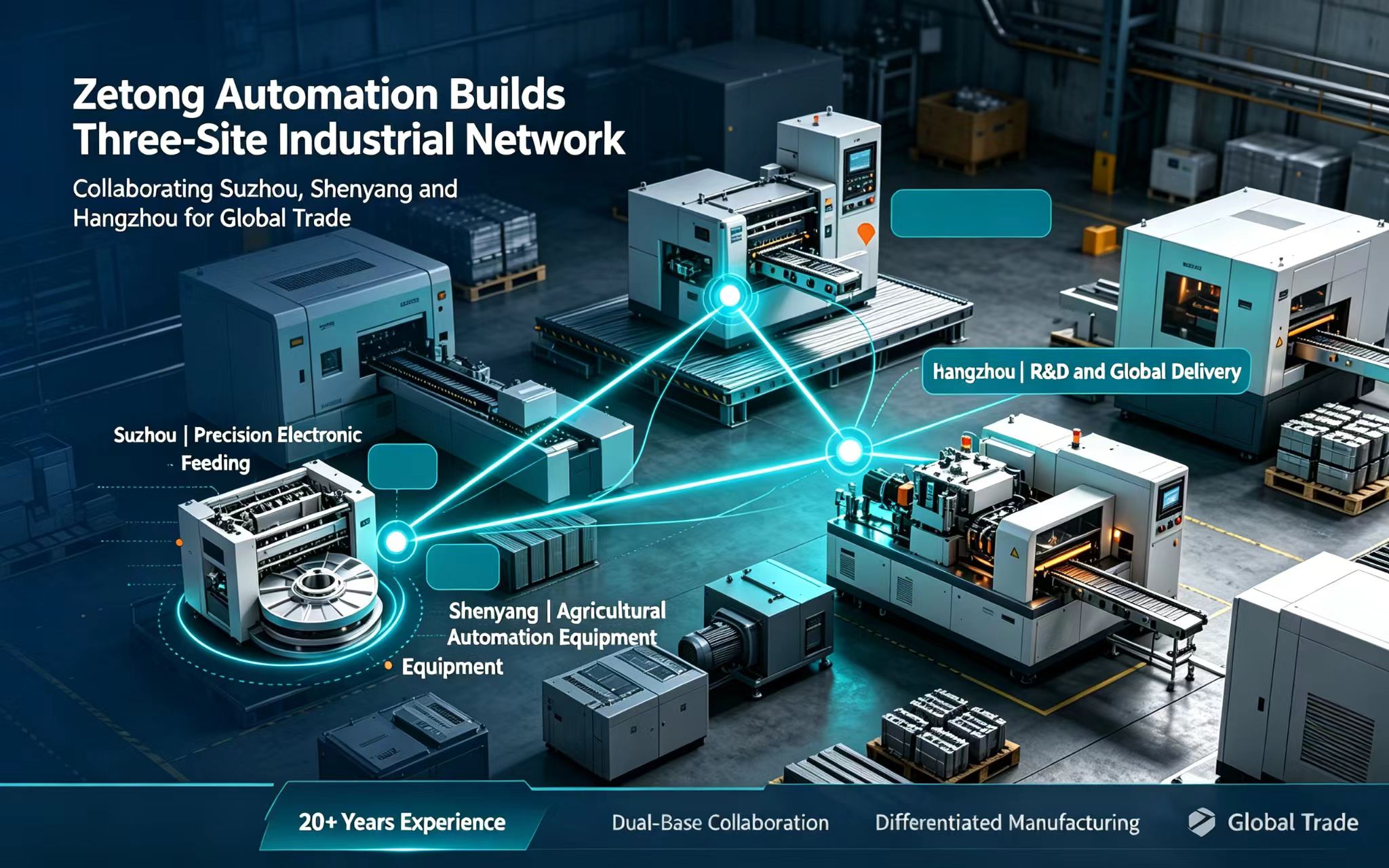
The industry is abandoning the extensive model of manufacturing feeders for all types of workpieces and shifting toward refined, scenario-focused and specialized production. Precision electronic feeding equipment relies on the mature supporting machining system in the Yangtze River Delta. Heavy-duty feeding equipment for large agricultural components requires robust structural design and high-strength commissioning technology. Differentiated dual-base production and multi-site collaborative manufacturing have become mainstream layouts for leading automation exporters.
3. Export Market Boom: Golden Era for Chinese Automation Equipment Export
2025–2026 marks the fastest-growing period for the export of China’s non-standard automated feeding equipment.
The manufacturing sector in Southeast Asia is booming. Numerous new electronic, assembly and hardware factories are building production lines, driving strong and continuous demand for complete feeding sets including vibratory bowl feeders and linear vibrators. Meanwhile, buyers from Europe, America and the Middle East are gradually reducing reliance on high-priced equipment from Japan and Germany, and sourcing cost-effective Chinese automation equipment with CE certification, flexible lead times and responsive service.
Overseas buyers adopt clear procurement criteria:
Prioritize stable, low-failure equipment for long-term continuous operation
Prioritize machines equipped with intelligent digital control systems
Prioritize reputable original manufacturers with factory strength and rich experience in segmented industries
Buyers no longer focus merely on price. They attach greater importance to quality control, craftsmanship, customization capability and after-sales support.
Low-cost manufacturers are being eliminated from the export market, while technology-focused, quality-oriented and scaled suppliers keep securing overseas orders.
4. Key Industry Development Trends 2026–2027
4.1 Full intellectualization: Digital controllers replace traditional analog units
High-end export models will all be equipped with intelligent digital voltage regulating control systems, delivering stabilized amplitude, frequency adjustment and low failure rates. Intelligence will become a standard configuration for exported feeding equipment.
4.2 Deep market segmentation: Separate development for precision electronics and heavy agricultural feeding
There will be no universal "one-size-fits-all" vibratory bowl factory in the future. Enterprises must build advantages in specific niche segments to maintain competitiveness.
4.3 Modularization, standardization and internationalization
Export orders demand modular machine design, standardized production, complete English documentation, full certification and compatibility with global voltage specifications. International standardization will become the mainstream requirement.
4.4 Quality stability prevails over price competition
Global purchasers have upgraded their awareness: The highest cost for automation equipment is downtime, malfunctions and after-sales losses. Reliable, durable and low-maintenance high-quality feeding equipment will continuously capture mainstream market share.
5. Conclusion
Overall, the vibratory bowl feeder automation industry is undergoing thorough reshuffling and quality upgrading. While the low-end market remains trapped in price wars, the high-end export market keeps expanding. Technology, practical experience, quality control, segmented layout and intelligent electronic control systems have replaced price as the core of industrial competition.
In the coming years, automation enterprises that dig deep into niche segments, master self-developed control technology, employ skilled veteran technicians and operate multi-site scaled production will continue to lead the global automated feeding export market, acting as a backbone for high-quality Chinese manufacturing going global.